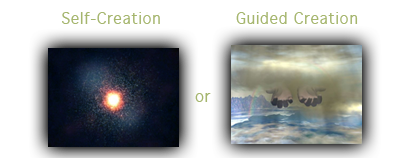
Self-Creation:
Origin of the Universe
Since Einstein's general theory of relativity and the discovery of the cosmic microwave background radiation in 1964, the "Big Bang Theory" and the related theory of cosmic inflation have been the dominant scientific explanations for the origin of the universe. In this view, the universe began about 13.8 billion years ago. Everything came from an initial speck of infinite density (also known as a "singularity"). This speck for some reason exploded (started expanding). Before that explosion, there was no time, no space, no energy, and no matter. Over the next 9 billion years or so, the newly formed space, time, matter and energy developed into remarkably ordered stars, galaxies and planets, including our earth.
Less common scientific theories about the origin of the universe, or about what came before the Planck epoch, include chaotic inflation with its "bubble universes" (the multiverse), the Big Bounce and the ekpyrotic model. The multiverse is also this view's main answer to fine-tuning: if there are countless universes, each with different laws and constants, it is no surprise that at least one is suited to life, and that we find ourselves in it.
Origin of Life
There have been many theories over the years about the origin of life. It remains a very active area of research (called abiogenesis), and there is still no standard theory. The general belief is that on the early earth, life arose from non-living matter through a natural, mechanistic process. That first life form then evolved into more complex life forms through random mutation and natural selection.
The theories differ on what sparked the first life and where it happened. Proposed triggers include lightning acting on hydrogen cyanide, methane or ammonia; self-copying RNA molecules (the "RNA world"); and autocatalytic chemical networks. In the famous Miller-Urey experiment of 1953, electric sparks passed through a mixture of methane, ammonia, hydrogen and water vapor produced amino acids, the building blocks of proteins. Proposed settings include a warm pond, montmorillonite clay, micelles, submarine hydrothermal vents and rock below the earth's surface.
How far that is from a living cell is widely acknowledged. Francis Crick, co-discoverer of the structure of DNA, wrote that the origin of life "appears at the moment to be almost a miracle", so many are the conditions that had to be satisfied to get it going. See the Resources page for more. |
Guided Creation:
Origin of the Universe
With guided theories, the details of how the universe began depend on the specific theory. Some hold that a creator made the universe recently and directly; others hold that a designer worked through the Big Bang over billions of years. What they share is the conclusion that the universe was guided and finely tuned by a designer. The evidence offered includes:
- General relativity and the cosmic microwave background radiation, which show that the universe had a beginning.
- The fine-tuning of the laws and constants of physics throughout the universe. The cosmological constant, for example, is often cited as tuned to about one part in 10^120.
- Our planetary system, with large outer gas planets that act as shields for the earth.
- The earth's location in the galactic habitable zone.
- The earth's orbit around a stable G2 dwarf star (the sun), at the right temperature within the circumstellar habitable zone.
- A moon that stabilizes the earth.
- The ideal view of solar eclipses from earth.
- The earth's nearly circular orbit and suitable mass.
- A finely tuned terrestrial environment, with an oxygen-rich atmosphere and liquid water.
Finally, there is the mathematical improbability of all of this coming together in one place, unguided, in the roughly 4.4x10^17 seconds (13.8 billion years) since the universe began. The astronomer Fred Hoyle, who coined the term "Big Bang", concluded that it looks as if "a superintellect has monkeyed with physics".
Origin of Life
As with the universe, the details of how life began depend on the specific theory. Life could have been seeded and guided by a divine creator, an alien intelligence and so forth. The signs of intelligence offered include:
- The digital information stored in the cell, and the cell's information-processing system.
- The overall complexity of DNA.
- The mathematical improbability of amino acids sequencing correctly without guidance. The biologist Douglas Axe has estimated that as few as 1 in 10^77 sequences of 150 amino acids form a working protein fold.
- The irreducible complexity of the molecular machines and circuits in the cell.
- The protein synthesis process.
- The pattern in which the major groups of organisms appear in the fossil record, above all the sudden appearance of most major animal groups in the Cambrian explosion.
- Even the phenomenon known as "homology", evidence once thought to give unequivocal support to neo-Darwinism.
Looking at the digital information in DNA, we can ask what causes are known to produce specified information or digital code. Charles Lyell called these "causes now in operation". Put simply: how does a computer program get written? Bill Gates has written that DNA is "like a computer program but far, far more advanced than any software ever created". Charles Darwin reasoned the same way, accepting the best available explanation until a better one comes along. The only known source of digital code and specified information is an intelligence. See the Resources page for more.
Two possibilities, one universe. Weigh the evidence for each, and decide which better explains why anything is here at all.
Looking for The Story of Everything documentary? (We are not affiliated.)
https://www.thestoryofeverything.film
The Story of Everything is a cinematic exploration of the cosmos that reveals the hidden hand behind our universe. From the precise laws that govern the stars to the intricate patterns found in every living cell, the film traces evidence of intentional design throughout nature. Whether examining distant star-forming clouds or the spiral structure of DNA, we discover a consistent signature woven into the fabric of existence.
|
|